

From Quote to Order: How Suppliers Can Convert More B2B Quote Requests
A B2B quote request signals genuine buying intent, but turning that interest into a confirmed order requires more than sending a price.
For chemical suppliers, raw-material distributors and industrial wholesalers, buyers often need confirmation of product specifications, stock availability, packaging, delivery requirements and commercial terms before they can proceed. When this information is handled manually across disconnected systems, opportunities can stall.
The aim is to make the path from enquiry to order clear, accurate and easy to manage..
Why do B2B quote requests fail to become orders?
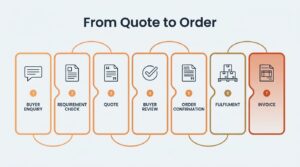
A buyer may have a real requirement but still delay or abandon a purchase when the quotation process creates uncertainty. Slow responses, incorrect product grades, unconfirmed stock, unclear minimum order quantities, missing technical documents, inconsistent pricing and limited follow-up can all prevent a quote from progressing.
In industrial trade, a quotation must answer more than “How much does it cost?” Buyers also need confidence that the supplier can provide the right product, quantity and delivery arrangement.
What information should suppliers capture before quoting?
A reliable quote starts with a clear understanding of the buyer’s requirement. Before preparing a quotation, suppliers should confirm the product name, grade or specification, quantity, packaging, intended application where relevant, delivery location, required delivery date, documentation, payment terms and whether the purchase is one-off or recurring.
For example, a request for citric acid may refer to a particular form, grade and packaging requirement. Quoting a different specification can result in the wrong price, even when the product name appears to match.
Capturing accurate information at the start reduces unnecessary back-and-forth and helps sales teams prepare a quote the buyer can act on.
How does inventory visibility affect B2B sales?
A supplier cannot confidently sell what the sales team cannot confidently see.
When inventory information is spread across spreadsheets, warehouses or separate systems, sales teams may need to confirm availability manually before responding. This creates delays and can lead to inconsistencies between what a salesperson promises and what the business can fulfil.
Connected inventory visibility gives sales teams a clearer view of what is available, where it is located and whether an order can be supported. This is especially important for suppliers operating across multiple warehouses or locations.
How can suppliers reduce the gap between quote and order?
The most effective fix is connecting the information involved in the transaction, so that customer details, product information, quotations, orders and invoices are not rebuilt manually at every stage of the process.
A connected workflow can reduce repetitive data entry, improve visibility and give sales teams a clearer view of what happens after a quotation is sent. It also makes it easier to manage the full process from quote to order, fulfilment and invoicing.
Frequently asked questions
How quickly should a supplier respond to a B2B quote request?
There is no universal benchmark, but response speed should ideally be around 40 minutes to 4 hours, as it is one of the strongest predictors of whether a quote converts. A buyer comparing several suppliers will often move forward with whichever one responds first with an accurate, complete quotation.
What is the most common reason an accurate quote still fails to convert?
Weak or absent follow-up. A buyer who receives a correct quote but no further contact often defaults to the supplier who continues the conversation, even when the original quote was competitive.
Does a connected quote-to-order workflow only matter for large suppliers?
No. Smaller distributors managing multiple product lines and a single warehouse still lose orders to slow confirmation and inconsistent pricing. The scale changes; the underlying problem does not.
Chemical suppliers, raw-material distributors and industrial wholesalers who connect customer, inventory, quotation and order information in one place respond faster, quote more accurately, and convert a noticeably higher share of the enquiries they already have.
Book an Orbital demo to see how connecting customers, inventory, quotations, orders and invoicing in one workflow can help your team convert more quote requests into confirmed orders.



How to Prevent Overselling Across Multiple Warehouses and Sales Channels for Chemical Suppliers
Overselling across multiple warehouses and sales channels happens when a business accepts an order f

Why manual invoicing Is becoming a risk for chemical distributors
For chemical distributors, invoicing affects order fulfilment and cash flow. Each invoice must refle

Study Abroad, New Journey To Try On
Lorem ipsum dolor sit amet, consectetur adipiscing elit, sed do eiusmod tempor incididunt ut labore