

How to Calculate Reorder Points and Prevent Stockouts
For chemical suppliers and distributors, stock-outs can quickly affect sales, customer relationships and production schedules. If you cannot fulfil an order, customers may face delays or turn to another supplier. A reorder point helps your team replenish inventory before it reaches a critical level. It combines average demand, supplier lead time and safety stock to create a consistent purchasing trigger. In this guide, you will learn how to calculate a reorder point, which figures you need and how better inventory visibility can help prevent stock-outs.
What is a reorder point?
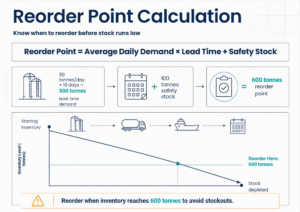
A reorder point is the inventory level at which you should place a replenishment order. The standard reorder point formula is:
Reorder Point = Average Daily Demand × Lead Time + Safety Stock
For example, if you sell 50 tonnes of a chemical per day and your supplier takes 10 days to deliver, lead-time demand is 500 tonnes. With 100 tonnes of safety stock:
Reorder Point = 50 × 10 + 100 = 600 tonnes
When available inventory reaches 600 tonnes, your team should trigger replenishment. The right figure varies by product, demand and supply conditions, but the calculation provides a consistent basis for purchasing decisions.
The three figures used in a reorder point calculation
1. Average daily demand
Average daily demand shows how much inventory you typically sell or use each day.
If you sell 1,500 tonnes over 30 days:
1,500 ÷ 30 = 50 tonnes per day
For products with variable demand, a basic average may not be enough. Review historical sales, seasonal patterns, customer schedules and recent market activity. A recent trend may be more useful than an average based on outdated data.
2. Supplier lead time
Lead time is the period between placing a replenishment order and having stock available for sale or use.
For chemical suppliers, it may include production, processing, transport, customs clearance, port handling and final delivery. If the usual lead time is 10 days, the reorder point must cover demand during that period.
3. Safety stock
Safety stock is additional inventory held to cover uncertainty in demand or replenishment.
A simple method for estimating safety stock is:
Safety stock (Maximum daily demand × maximum lead)
It can help when a customer places a larger-than-expected order, demand rises suddenly or a supplier delivery is late.
Too little safety stock increases stockout risk. Too much ties up working capital, warehouse space and cash. The aim is to hold enough inventory for the uncertainty you face, rather than adding a large buffer to every product
Reliable data and regular reviews support better reorder decisions
A reorder point is only useful when inventory data is accurate. Disconnected records can hide available stock, delay replenishment or lead to unnecessary purchases.
Connected inventory, order and availability data helps teams monitor stock across locations and identify products approaching their reorder points.
Review reorder points when demand, lead times, sourcing conditions or customer segments change. Regular updates keep replenishment rules aligned with current business conditions.
Improve chemical inventory management with better visibility
Preventing stockouts is not simply a matter of buying more inventory. It requires accurate demand information, realistic lead-time estimates, appropriate safety stock and a clear replenishment trigger.
Orbital connects inventory, orders, customers and invoicing in one operating view, helping chemical suppliers manage stock and fulfilment across their operations.
Request a demo to see how Orbital could help your team manage reorder points, inventory and orders in the way your business works.


